Claude Fable 5.2: Turning Long Tasks into Reviewable Workflows
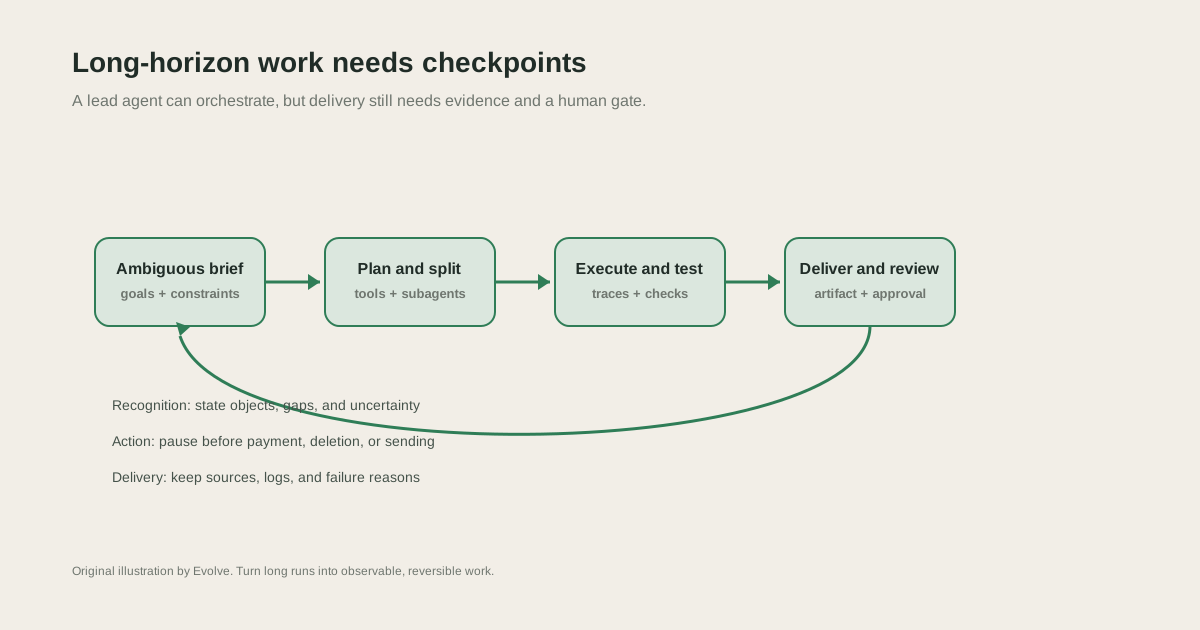
The upgrade is not simply “longer answers.” It is a model designed to keep moving through difficult coding, research, and design work while leaving checkpoints behind.
Claude Fable 5.2 launched on November 9, 2026. Anthropic positions it for the hardest knowledge and coding work: long-running agents, cross-repository migrations, research, and analysis that ends in a finished report. Fable 5.2 and Mythos 5.2 share the same underlying model; Fable is the broadly available configuration with stronger safeguards for cybersecurity and biology.
tokens
tokens
per MTok
speedup
The numbers point to long chains, not every prompt
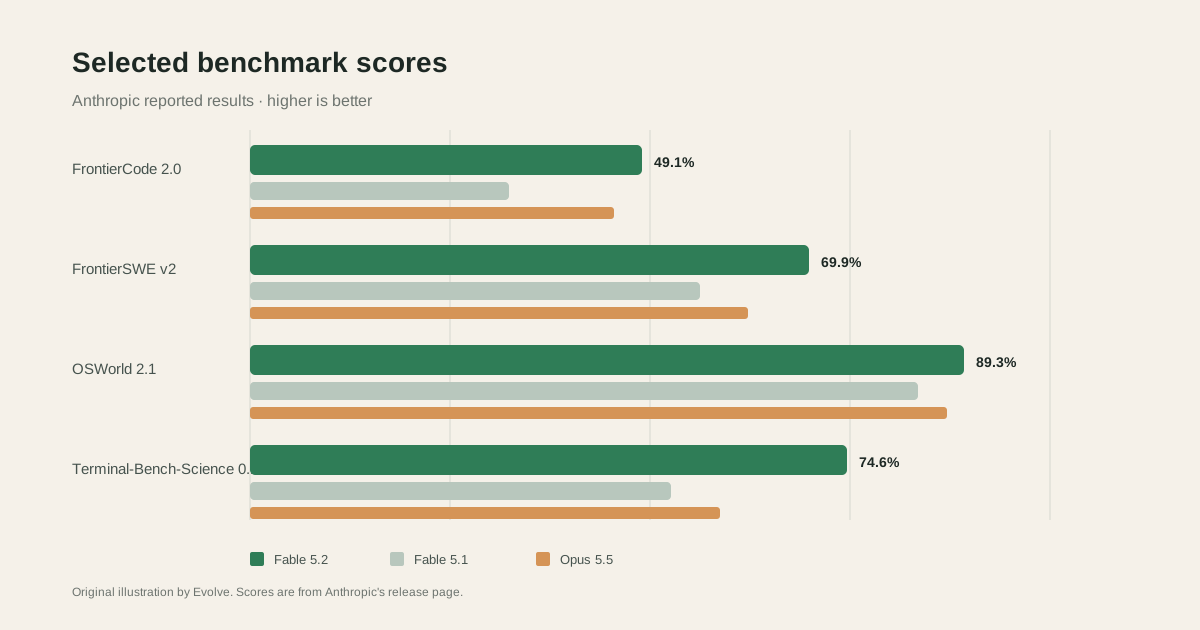
Anthropic’s table puts Fable 5.2 above Opus 5.5 on most listed capabilities. The clearest signal is in tasks that require decisions and tools to work together: FrontierCode 2.0 for agentic coding, OSWorld 2.1 for computer use, and Terminal-Bench-Science 0.1 for scientific agents.
| Benchmark | Fable 5.2 | Fable 5.1 | Opus 5.5 | What it tests |
|---|---|---|---|---|
| FrontierCode 2.0 | 49.1% | 32.4% | 45.5% | Agentic coding |
| FrontierSWE v2 | 69.9% | 56.3% | 62.3% | Software engineering |
| OSWorld 2.1 | 89.3% | 83.5% | 87.2% | Computer use |
| Terminal-Bench-Science 0.1 | 74.6% | 52.6% | 58.7% | Scientific agents |
Fable 5.2 also reports 51.4% on AutomationBench, 82.1% on WANDR’s relaxed score, 74.2% on Humanity’s Last Exam with tools, and 73.4% on Chartography. None of these numbers is your business success rate: tools, stopping conditions, test sets, and cost accounting all matter.
Price fell, but effort is the billing switch
Standard pricing is $8 per million input tokens and $40 per million output tokens, down 20% from Fable 5.1’s $10/$50. Cache reads cost $0.20 per MTok, and Batch API input and output receive a 50% discount. Fast mode can generate up to 2.5 times faster at $16/$80 per MTok.
The documentation treats effort as a resource dial: it changes thinking depth, tool calls, latency, and token use. Start at high, the API default; use low for clear high-volume tasks, medium for interactive work, and xhigh or max only when your evals show a gain.
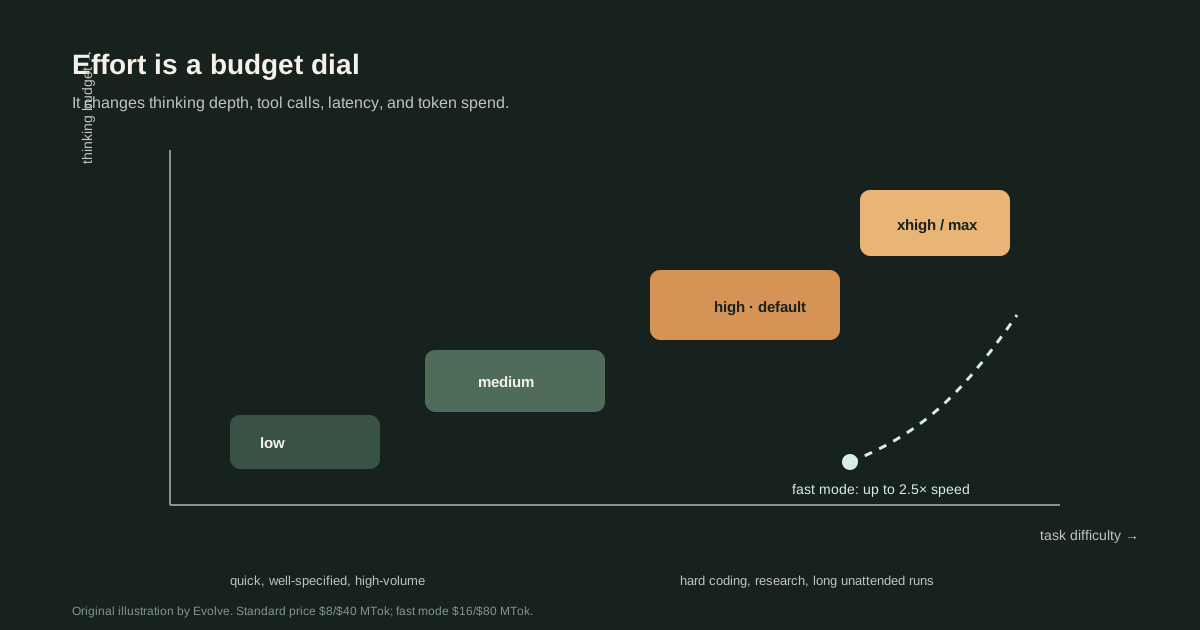
Anthropic says early FrontierCode testing put Fable 5.2 at high effort around Opus 5.5 at max effort for roughly half the task cost. That is a vendor test claim; your tool calls, retries, and input lengths decide the actual bill.
Migration: remove the 400 errors before traffic moves
Changing the model ID is the smallest part of a migration. Adaptive thinking is always on, so thinking: {type: "disabled"} is invalid. Fable 5.2 also defaults to high, while Opus 5.5 defaults to medium.
- Tool choice:
tool_choicevaluesanyandtoolreturn 400. Keepauto, state the desired action, and validate the tool schema. - Thinking blocks: return them unchanged in every tool loop, including empty blocks; select content by type rather than position.
- Computer use: outside Bedrock, replace
computer_20251124withcomputer_toolset_20260801. - Data retention: 30-day retention is required by default. Zero data retention needs an eligible Enterprise Frontier Safeguards path.
The migration guide also calls out separate rate limits and lower token ceilings, and says a Fable 5.2 executor can use only a Fable 5.2 or Mythos 5.2 advisor. Treat these as launch checks, not post-incident documentation.
Where it earns a real trial
Cross-repository migrations
Give the model acceptance criteria, compatibility constraints, and test commands. Let it inspect dependencies, make staged changes, run tests, and explain failures. The value is the trail of diffs and evidence, not just more code per turn.
Research to delivery
For work that reads papers, runs experiments, compares results, and produces a report, a large context can help. Require sources, assumptions, unresolved questions, and reproducible commands.
Hardware and visual design
Ask it to list objects, dimensions, and uncertainties before letting it generate CAD, code, or simulations. That gives a human a chance to catch a visual mistake before it becomes an action.
Conclusion: treat Fable 5.2 as a long-task lead
Claude Fable 5.2 moves the model from one-shot answers toward sustained work: split the goal, use tools, check the result, and revise until there is a document, code change, or research artifact. The lower price and larger context come with always-on thinking, stricter retention requirements, and API compatibility changes.
Choose one familiar process with measurable acceptance criteria. Run it at medium, high, and fast mode; record success rate, tokens, tool calls, human takeover, and rework time. That cost sheet is the meaningful answer for your team.