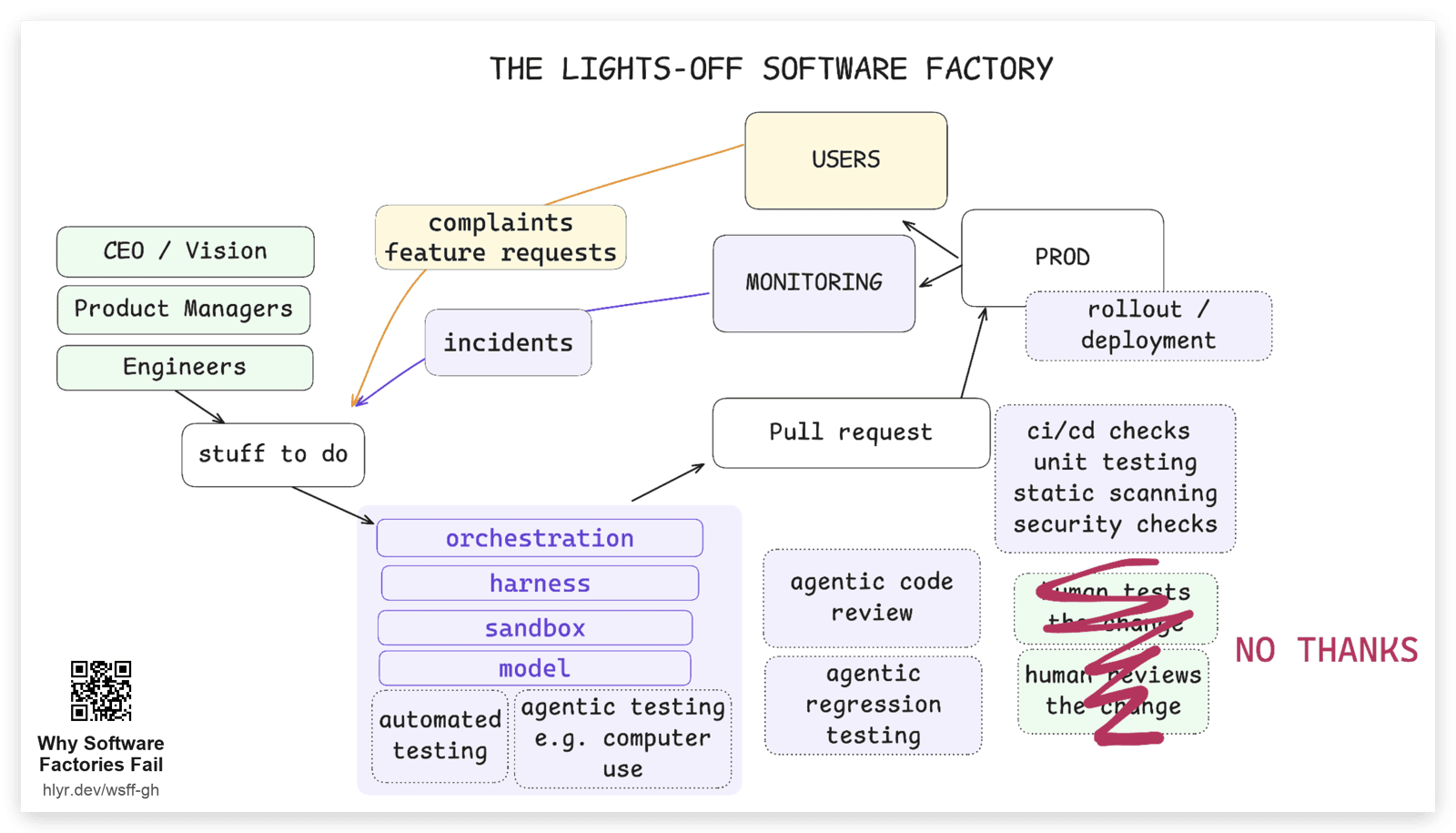
Harness engineering is not enough: why the software factory model fails
In July 2026, HumanLayer founder Dex Horthy delivered a keynote titled "Why Software Factories Fail" at the AI Engineer World's Fair. He expanded his talk into a long-form essay, split across two posts on July 24 and 25 due to X's media limits per post.
Part 1 is subtitled "Harness is Not Enough." The industry calls the environment surrounding AI coding models a harness—the tools provided, context fed, retry attempts, and automated review checks. Over the past year, engineering effort has focused heavily on refining this harness to achieve fully autonomous pipelines. His thesis: this approach cannot fix code quality because the issue lies in how models are trained, not in their harness.
Part 2, "Turning the Lights Back On," details the workflow his team adopted after learning these hard lessons. This breakdown synthesizes both parts.
The state of software factories and blind automation
Faros AI aggregated two years of engineering data across 22,000 developers and 4,000 teams. None of these numbers come from surveys; all were extracted directly from code repositories, CI pipelines, incident systems, issue trackers, and IDEs. They compared the same companies across periods of low vs. high AI usage.
Primary source and reference
- Dex Horthy(HumanLayer) Original publisher