LangChain: Tuning the Harness, Not the Model — Nemotron 3 Ultra Closes In on Opus 4.8 at About 1/10 the Cost, Proving Enterprises Don't Need to Pay Top Dollar for Closed APIs
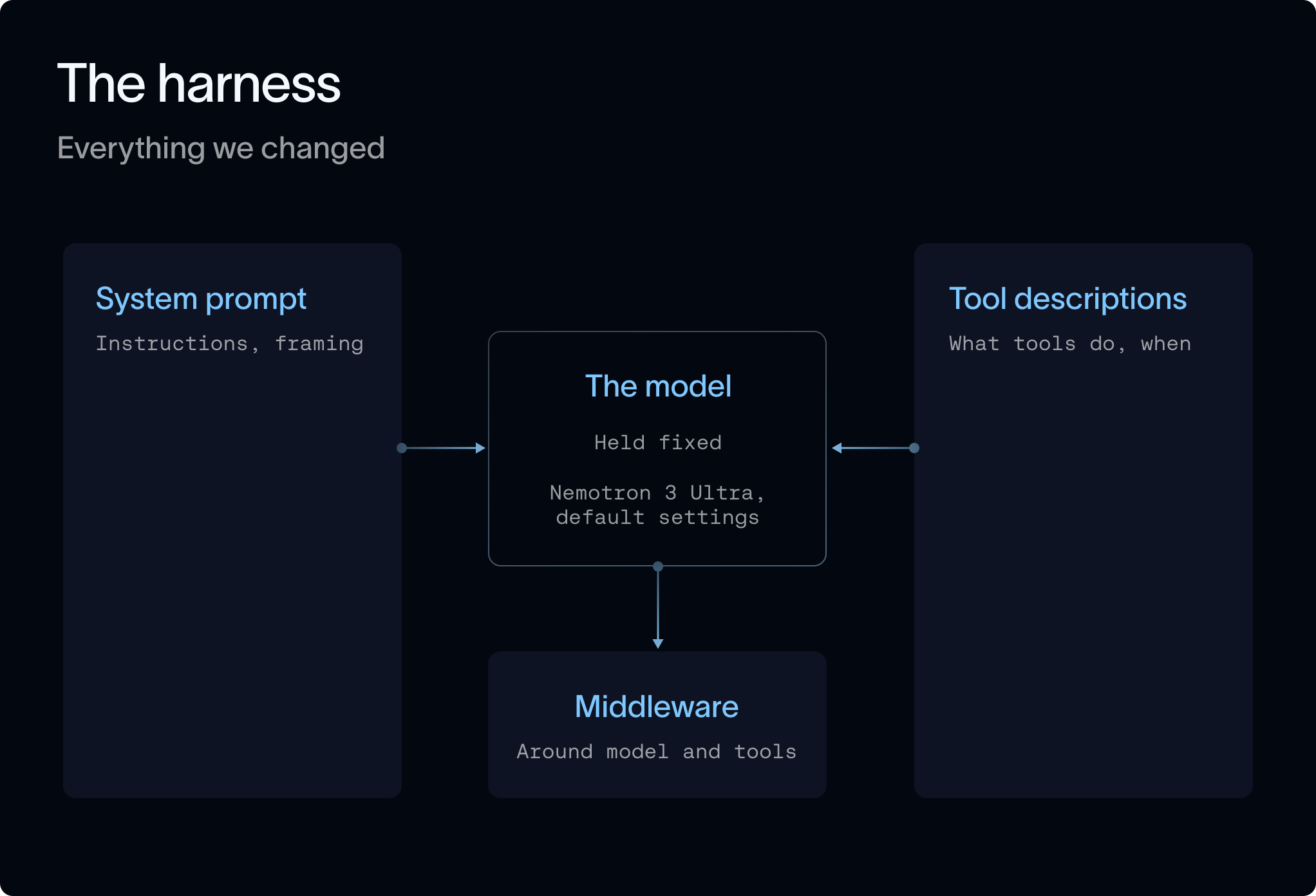
- LangChain froze the Nemotron 3 Ultra weights and only changed the harness (system prompt, tool descriptions, middleware) — no model changes, no touching temperature or other generation parameters.
- The method is an eval-driven loop: evaluate → read failure traces → cluster behaviors → change one part of the harness → re-evaluate; screen cheap on a small sample first, then run the full suite.
- Prompts use short, single-purpose instruction blocks; middleware handles enforcement plus injecting signals right at the failure point.
- Key mechanism: the same rule written in a tool description does nothing, but stuffed into the tool's return result it works; injecting mid-conversation is more reliable than a standing system-prompt rule.
- Typical run ~0.80→0.84, best run 0.86 versus Opus 4.8's best of 0.87; the full suite costs about $4.48 vs $43.48, with median latency around 10 seconds per question on both sides.
What They Did
LangChain published a harness-tuning playbook for Nemotron 3 Ultra: leave the model untouched, change only the scaffolding around it, and see how high an open model can be lifted on agent tasks.
In one line: same open model, a better-fitting shell — the best run closes in on Claude Opus 4.8, at roughly an order of magnitude lower cost for the full eval suite.
Why this matters: same weights, different scaffolding, and the score gap can be sizable. LangChain previously took gpt-5.2-codex from 52.8 to 66.5 on Terminal-Bench 2.0 without touching the model. This time they apply the same idea to an open model, with a cost comparison against Opus.
Generation parameters stayed at the vendor's recommended defaults. The gains in this piece didn't come from cranking temperature and hoping for the best.
When the Shell Doesn't Fit, Where Does the Horsepower Go
Open models can already carry real agent workloads at a fraction of the cost of frontier APIs. But even a capable model, dropped into a harness that wasn't built for it, will misfire.
Primary source and reference
- LangChain Blog Original publisher