
Princeton professor at ICML on AI and work: how should individuals adapt?
- Princeton CS professor Arvind Narayanan’s ICML 2026 keynote in Seoul, “What will be left for us to work on?”, builds on the “AI as Normal Technology” framework with Sayash Kapoor.
- SAGE lab: over ~24 months, frontier models jumped in capability; reliability (consistency / robustness / calibration / operational safety) rose only 5–10pp.
- In software’s decide–execute–deliver stack, AI mainly compresses execute (~1/3 of effort); decide and deliver are not compressed—and may expand.
- ATM, radiology, translation, software tools: automation rarely cuts jobs 1:1; software employment grew ~10,000× through many ~10× tool leaps.
- He splits RSI / human-level AI / economically transformative AI / superintelligence into four non-entailing dimensions.
- Personal adaptation: raise the ceiling, don’t only ride the floor; balance productivity / growth / control; refuse black boxes; master first, then amplify; reinvest ~10 hours/week into skills.
Two narratives: the AI field is anxious about its own jobs
At ICML 2026 in Seoul, Princeton CS professor Arvind Narayanan gave a keynote titled “What will be left for us to work on?”
He splits the path into two practical camps—not pure philosophy:
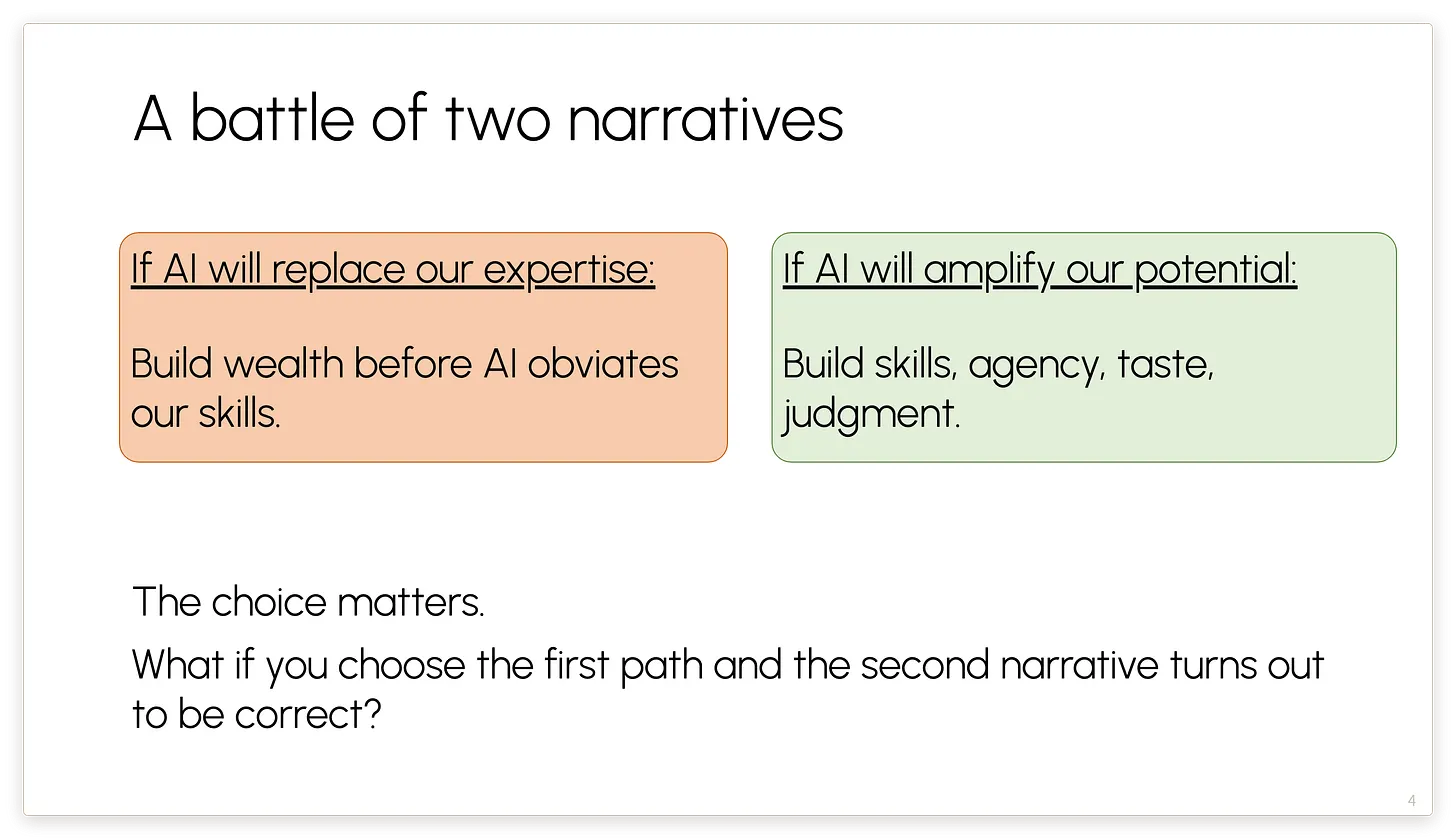
If you bet on replacement and amplification wins, you may miss the best window in history to build superpowers. The world is watching how the AI community responds; rolling over and accepting “AI will do the work” may fuel a sharper political backlash.
Four stages of AI impact—the slowest has barely begun
“Normal” in AI as Normal Technology does not mean AI is a hammer or a toothbrush. They treat it as industrial-revolution scale, as a causal model of how capability becomes economic and social impact.
Classic diffusion: invention → innovation (appliances) → adoption. They expand it into four stages, with software as the example:
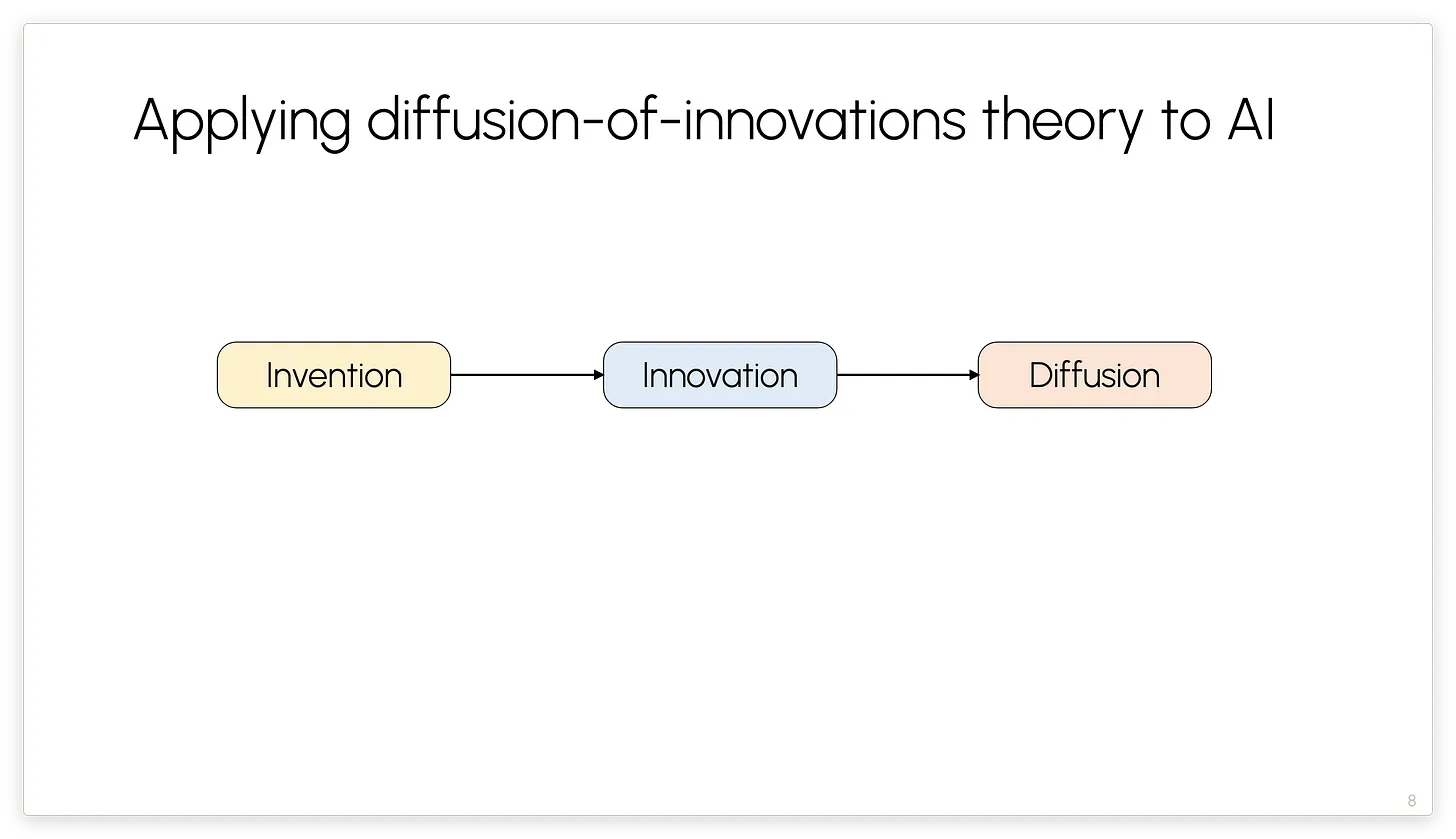
Stage four is slowest. Even in software—an early coding-agent adopter—true organizational redesign has barely started. Speculation: if agents can ship huge, secure codebases, one-size-fits-all software for billions makes less sense; software becomes extremely personalized, and even “software company” as a form may be renegotiated. That is human and organizational change—historically measured in decades.
Electricity in factories: drop-in replacement never worked
Pre-electricity factories used one giant steam engine and mechanical transmission. Owners first tried swapping boilers for generators—“more efficient drop-in.” It failed.

Today agents are sold as drop-in human replacements. Electricity’s lesson: the payoff is reorganizing work, not cloning a person with a machine. That was not the utility’s job—and AI’s org redesign is not only AI companies’ job. In their four stages, this is the slowest; it has barely opened.
Measured: capability rose; reliability lagged
There is a huge gap between what occupations could use AI for and what they actually use. Adoption lag is one reason; deployers may also feel walls beyond leaderboard scores sooner than vendors admit.
Reliability is the #1 cited concern. SAGE clusters ~10–12 metrics into four dimensions:

General + high-stakes + fully autonomous looks like pick-two. Collaboration agents will keep outperforming full automation agents; scaffolding and post-training should differ—not one “more automatic is better” story.
Software engineering: writing code was never the bottleneck
Papers said this by 2019. The last year of blogs “rediscovered” it: coding agents sped the middle layer; the whole job did not shrink in proportion.

Machines do cognitive heavy lifting; humans stay in control. The job becomes operating the machine, not hauling every brick by hand. Cranes did not erase job sites—they rewrote who does what.

Lump-of-labor fallacy: automation rarely cuts jobs 1:1
The fallacy: work is a fixed pie; AI takes a slice and jobs permanently vanish. History often shows demand and job structure changing with efficiency.

Software itself: many ~10× tool leaps from machine code onward; employment rose ~10,000× because code demand grew faster. Not “nobody ever loses a job”—just “automation rate ≠ unemployment rate.”
If RSI arrives: four dimensions that get smushed together
Labs race toward recursive self-improvement (RSI). He takes it seriously—without equating a lab milestone with “humans instantly have nothing left to do.”

Early explorers could name a whole archipelago “Hawaii.” Up close, if you still do not name islands, you get lost about where to sail. RSI, human-level AI, economically transformative AI, and superintelligence are often chained as automatic dominos—he wants them unbundled.

Curing cancer is often gated by thousand-patient, multi-year trials—external constraints more compute cannot delete. Mapping “model milestone” straight to “society has no work left” skips those walls.
Why AI creativity lags—and open-world evaluation
Perception representations are strong; representations that support creativity and high-level reasoning still lag, in his view. Hypotheses from cognitive science and practice:

SAGE open-world evaluation: give agents a few thousand dollars plus a real ML problem a human expert spent months on (paper not yet on arXiv), then have those experts grade outputs. They also ran “ship an iOS app to the App Store” style tasks and are recruiting senior researchers to expand.
How should individuals adapt in this wave?
After the framework, Narayanan’s “Personal reflections on adapting to AI” is not a universal playbook—he shows how he is surviving the capability treadmill in his own research workflows.

Pick a stance: replacement vs amplification
The opening narratives become life configurations:
Floor and ceiling: where reinvested time goes
His practice: when AI buys big productivity, reinvest the surplus into long-term growth and complementary skills/workflows—about 10 hours/week learning and experimenting.
“If I don’t feel exhausted at the end of the day, I’ve done something wrong. I’ve offloaded too much to AI—sacrificing long-term growth for short-term productivity.”
Three-legged stool: productivity · growth · control
Only productivity → crushed when the floor rises. Only growth → you do not ship. Both without control → a button-clicker over time.
Two heuristics to keep control
Machines lift; humans stay in the cab. The job becomes operating, understanding, and controlling the machine—not being a brick on the schedule. Adaptation means not climbing out of the cab.
Closing vision: human–AI co-superintelligence
Economically transformative AI is already starting—not via an AGI switch, but via slow variables: reliability, integration, tacit knowledge, regulation. He rejects geopolitics as “whoever hits a capability milestone first takes all economic value.”
On superintelligence: tasks have ceilings; human intelligence leans on learning and tools, so AI is another tool and the contest is more “AI-augmented humans” vs “AI alone”; treating “AI owns companies and hires/fires” as default and hoping alignment alone saves us is “less pro-safety than anti-safety.”

Computers were “bicycles for the mind”; he calls AI a “crane for the mind.” The learning curve is steep—a treadmill—but co-superintelligence is a fight worth fighting: not abandoning work, but redefining it as higher-ceiling collaboration with AI.

The capability floor rises on its own; the ceiling you must push. Adaptation is not dumping all work on AI—it is reinvesting saved time into complementary skill while staying in the driver’s seat. From Arvind Narayanan · ICML 2026 keynote
Primary source and reference
- AI as Normal Technology Original publisher