
Meta releases Muse Spark 1.1, rivaling GPT-5.5 and Opus 4.8 across multiple agentic evals
- Meta Superintelligence Labs releases Muse Spark 1.1: a multimodal reasoning model built for agentic tasks; the Meta Model API opens in public preview simultaneously, and the model enters Thinking mode in Meta AI / meta.ai on the consumer side.
- Core capabilities: a lead agent orchestrating parallel sub-agents, active management of a 1-million-token context window, desktop/browser/mobile computer use, coding, and multimodal task execution.
- Wang published a comparison table: JobBench 54.7, MCP Atlas 88.1, HLE (with tools) 62.1, and other agentic lines match or beat GPT-5.5 / Opus 4.8; the coding line is close to top-tier.
- Official pay-as-you-go pricing: $1.25 input, $0.15 cached input, $4.25 output (per million tokens); web search grounding $2.50 per 1,000 queries; no long-context surcharge.
- Compatible with the OpenAI SDK, Anthropic SDK, OpenCode / Claude Code, and more; all three API formats share the same model and pricing.
Let's get this straight first
On July 9, 2026, Meta Superintelligence Labs released Muse Spark 1.1 and, for the first time, put this model in the hands of outside developers through the Meta Model API. That same day, Meta Chief AI Officer Alexandr Wang posted a thread that put it plainly:
muse spark 1.1 is an industry-competitive agentic and coding model. across many agentic evals it rivals gpt-5.5 and opus-4.8. available now through the new meta model api and in meta ai. — Alexandr Wang, @alexandr_wang, 2026-07-09
In plain terms: this isn't a small "chat feels a bit smoother" update — it's built for getting agent work done and writing code. Across multiple agentic evals, the official claim is that it can go toe-to-toe with GPT-5.5 and Opus 4.8. Below, we'll lay out the full feature set first, then walk through how it works, how to read the numbers, and what it costs.
What can it actually do: the capability table first
Once you've read this table, the rest of the article is just filling in each row in detail. Read it through once, then scroll down to the videos and benchmarks.
The throughline in one sentence: first it learns to divide work in parallel like a project manager, then it ties desktop/browser/mobile operation and coding into the same agentic pipeline, and finally it's handed to developers through an API that pairs "high scores" with "relatively low prices."
How the agent gets work done: the lead agent delegates, sub-agents run in parallel
Both the official materials and Wang frame "agentic performance and tool use" as the leading edge. The mechanism isn't mysterious — it breaks down into three steps:
- The lead agent thinks firstIt gathers context, makes a plan, and decides how to split the work into sub-tasks, rather than clicking through every screen itself in one go.
- Sub-agents execute in parallelEach one stays within its task boundary and figures out the tools at hand (native tools, MCP, custom skills), escalating back to the lead agent when it can't proceed.
- Context is actively managedThe 1-million-token window isn't just filled and ignored: it remembers what's been done, pulls facts back from earlier work, and when nearing capacity, compresses idle chatter while keeping decisions and unfinished steps.
context + plan
coding / tools
browser / desktop
retrieval / verify
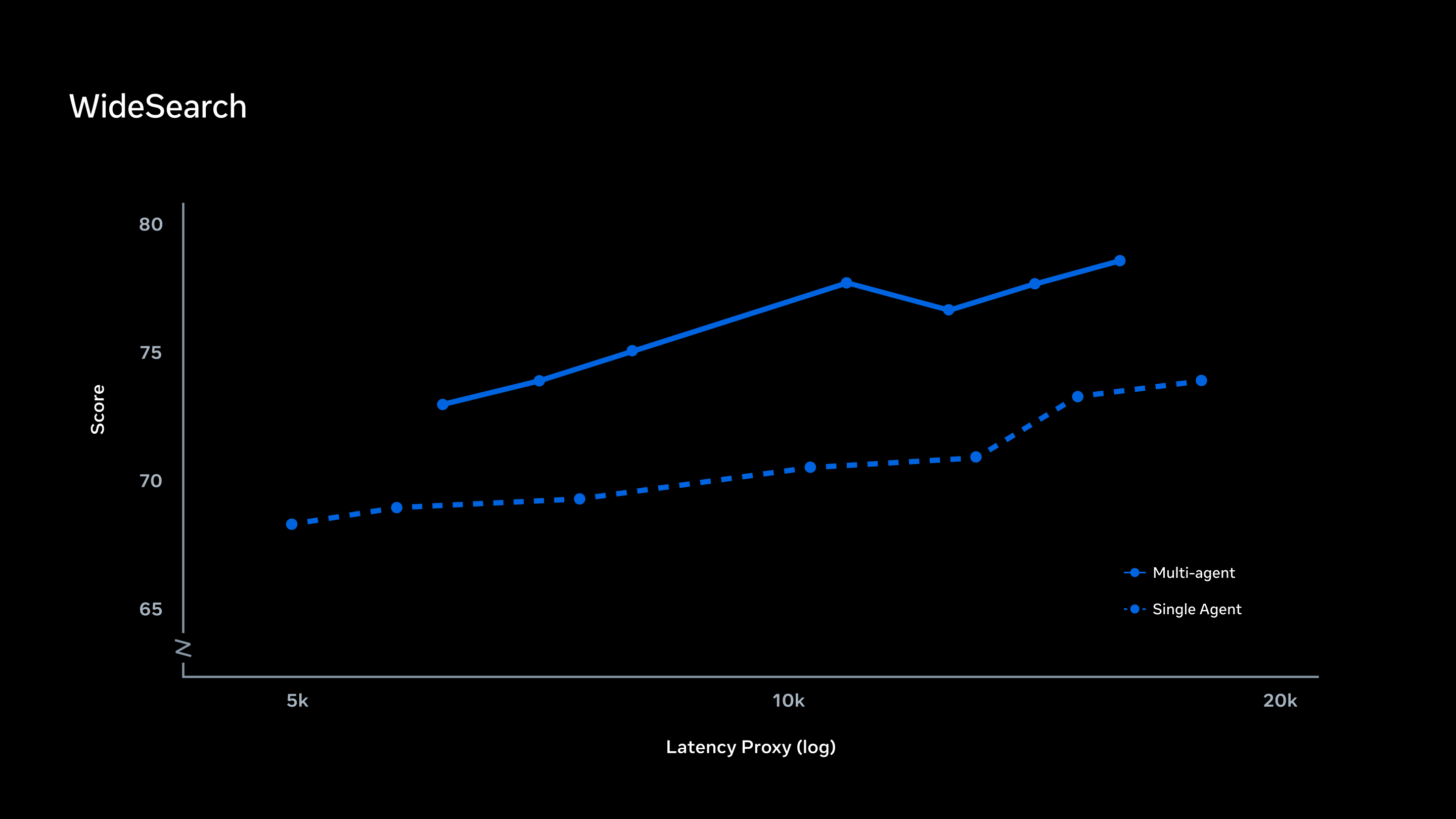
The official materials also stress zero-shot generalization to new native tools, MCP servers, and custom skills, without needing to retrain on each one separately. On the WideSearch chart, at the same latency point, multi-agent scores beat single-agent scores — parallelism is a training objective, not an interface flourish.
Computer use: desktop, browser, and mobile all fair game
Wang was specific about this: it can operate desktop, browser, and mobile. The training focus isn't "click every single step" — it's judgment calls like:
- Automation via script is faster → write the script
- Direct UI interaction is simpler → click, type, scroll
- Each step can produce a batch of actions, not one click at a time
Hand an intern a remote device and just tell them the goal. They decide for themselves: open the app and tap a few times, or write a script to batch-check menus and inventory.
Official dinner-party demo: as the guest count, dietary restrictions, and inventory change mid-task, it notices and revises the plan on its own, without waiting for another instruction.
Coding: large repos, multiple turns, self-verified via screenshots
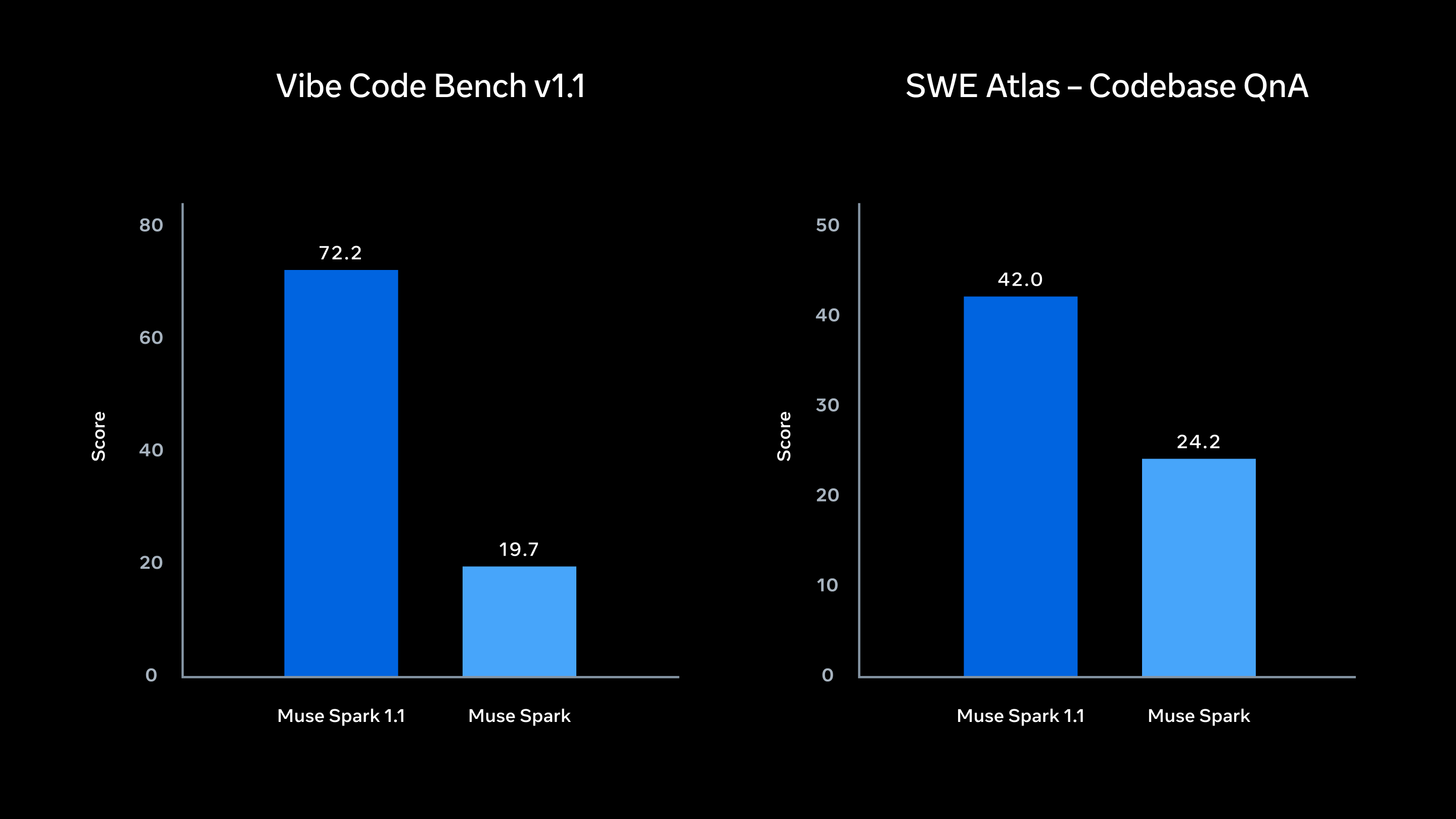
Wang calls this a major step forward on real large-scale codebase tasks; the model was trained to fit common agentic coding setups. The official demos chain coding, image reading, and tool calling together:
Multimodal: seeing the details, then acting on them
Document-side capabilities include: image understanding (photos/charts/documents/screenshots), video understanding, and document perception. The signature use case isn't "describe this image" — it's connecting perception directly to action.
Muse Image / Muse Video also launched the same week, on the media-generation side, complementing Spark's agentic line.
Image-generation mechanics are covered in that piece. This article covers only Spark's agentic / coding / API line.
Across multiple agentic evals: where it leads, where it's just on par
The summary table below comes from the image Alexandr Wang attached to his tweet (matching the Meta Muse Spark product page). All the numbers are laid out here — no need to click through tabs.
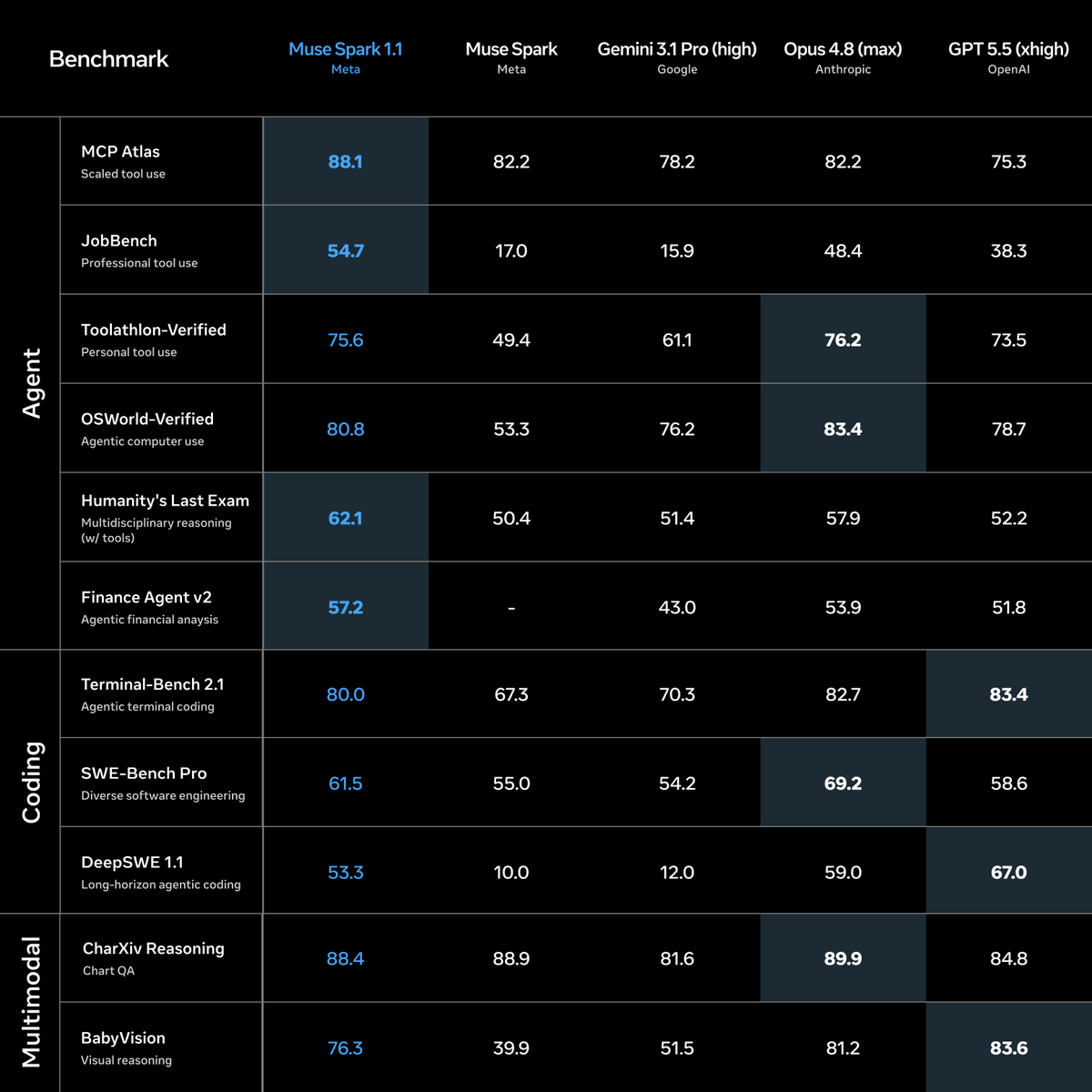
| Category | Benchmark | Spark 1.1 | Previous gen | Opus 4.8 | GPT-5.5 |
|---|---|---|---|---|---|
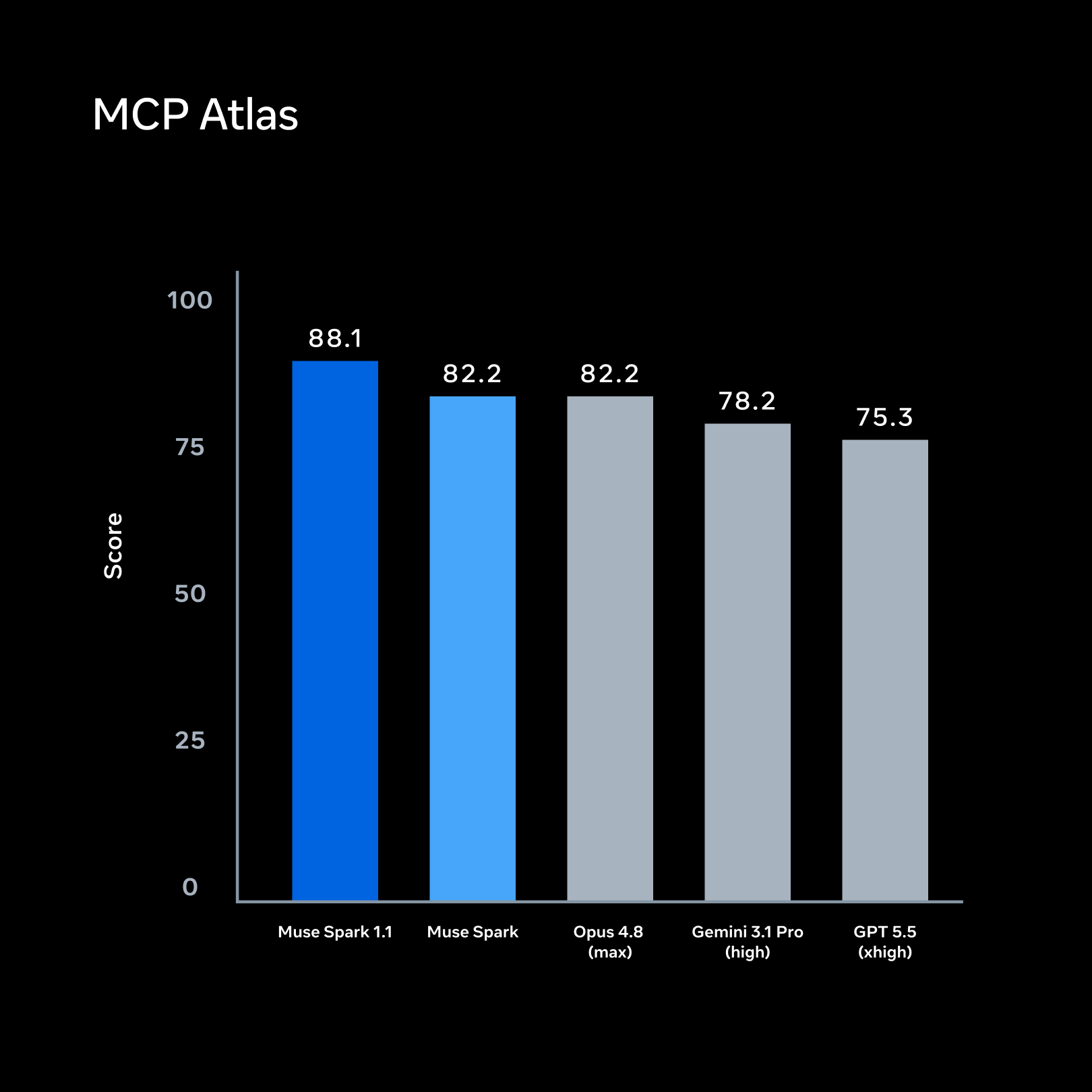
| Agentic | MCP Atlas | 88.1 | 82.2 | 82.2 | 75.3 |
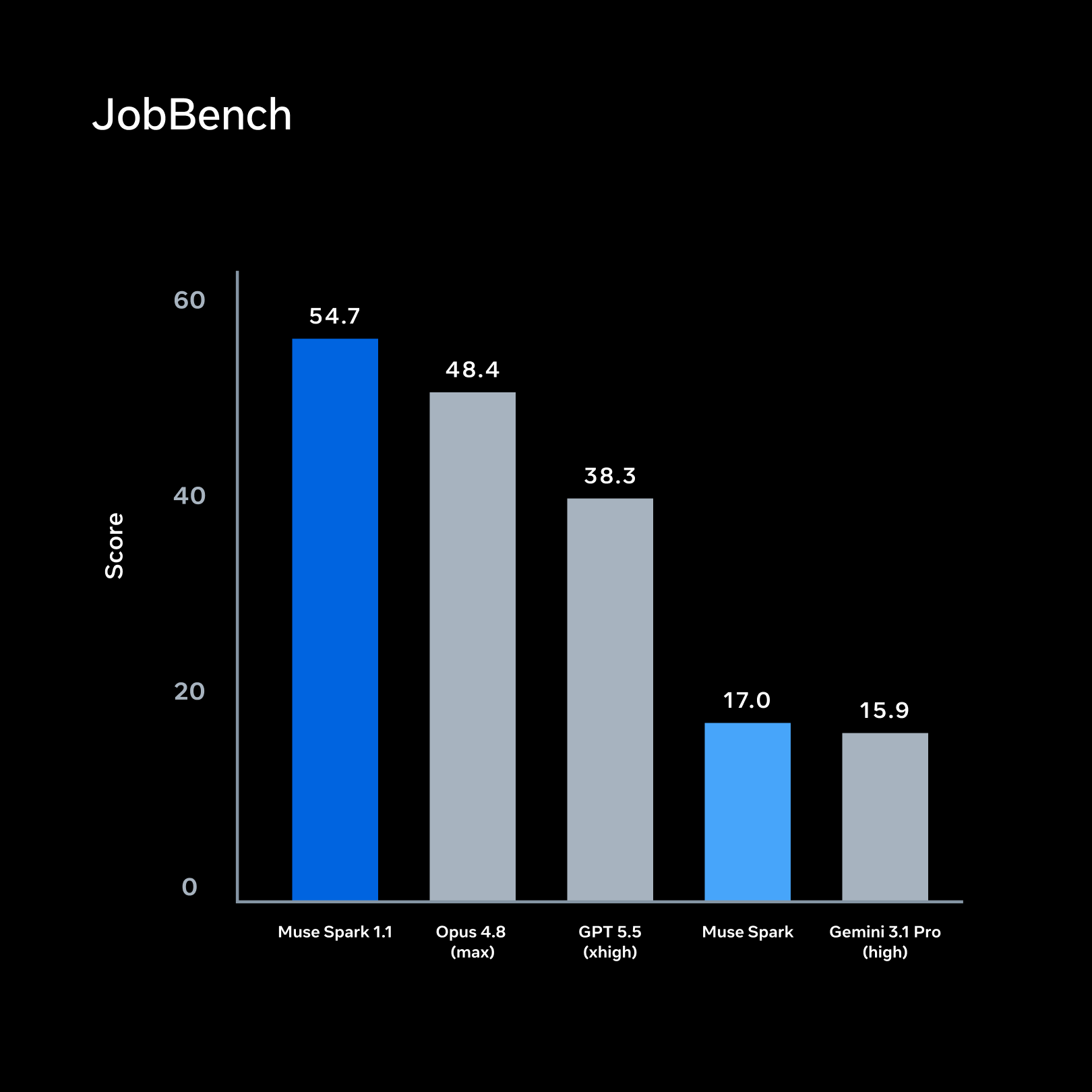
| Agentic | JobBench | 54.7 | 17.0 | 48.4 | 38.3 |
| Agentic | Toolathlon-Verified | 75.6 | 49.4 | 76.2 | 73.5 |
| Agentic | OSWorld-Verified | 80.8 | 53.3 | 83.4 | 78.7 |
| Agentic | HLE (with tools) | 62.1 | 50.4 | 57.9 | 52.2 |
| Agentic | Finance Agent v2 | 57.2 | - | 53.9 | 51.8 |
| Coding | Terminal-Bench 2.1 | 80.0 | 67.3 | 82.7 | 83.4 |
| Coding | SWE-Bench Pro | 61.5 | 55.0 | 69.2 | 58.6 |
| Coding | DeepSWE 1.1 | 53.3 | 10.0 | 59.0 | 67.0 |
| Multimodal | CharXiv Reasoning | 88.4 | 88.9 | 89.9 | 84.8 |
| Multimodal | BabyVision | 76.3 | 39.9 | 81.2 | 83.6 |
Where the official numbers make the strongest case for leading: MCP Atlas, JobBench, HLE (with tools), Finance Agent v2, and other agentic lines — 1.1 is often highest or second-highest in the table.
Neck and neck: Toolathlon and OSWorld are close to Opus; Terminal-Bench trails GPT-5.5 / Opus slightly.
Still behind: DeepSWE 1.1's 53.3 is below GPT-5.5's 67.0; BabyVision is below GPT-5.5's 83.6. This is not "across-the-board dominance."
Versus the previous generation: JobBench 17.0→54.7, DeepSWE 10.0→53.3, OSWorld 53.3→80.8 — big jumps.
What it costs, and how to plug it in
Wang's framing is "premium performance at low cost." The exact numbers are on the Meta Model API pricing page — pay-as-you-go, no minimum spend, no prepayment:
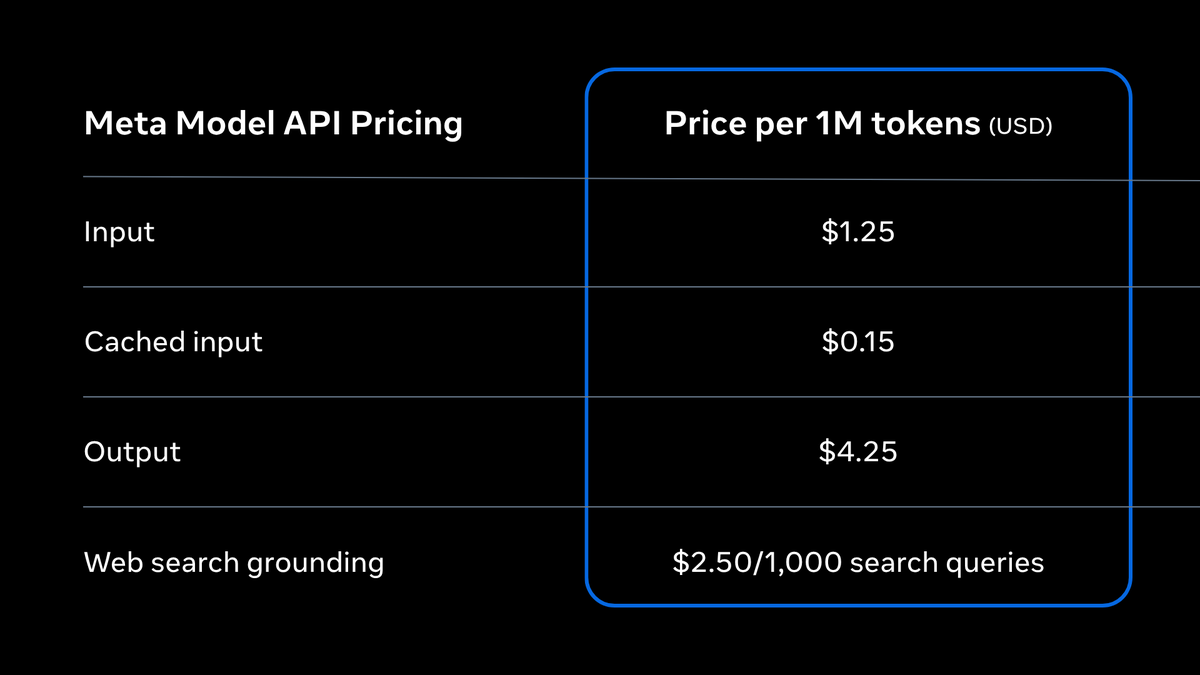
- No long-context surcharge: pricing is the same whether the window is nearly empty or nearly full
- Prompt caching: when a prefix hits the cache, it's billed at the cached-input rate — check cached_tokens in the response
- All three APIs (Responses / Chat Completions / Messages) share the same model and the same price; Responses has the fullest feature set and suits agentic workflows best
- Rate limits (per team): free tier 60 RPM / 2M TPM; paid tier 3,000 RPM / 4M TPM
- A small number of system-injected guidance tokens aren't billed
What's ready out of the box in the API
- Parallel tool calling + streaming tool arguments
- Cross-turn reasoning (reasoning can carry across turns)
- Web search grounding, with inline citations
- Image / video understanding
- Structured output (JSON to schema)
- Files API: upload once, reference by ID
- Prompt caching to cut latency and cost
- reasoning_effort adjustable per request, from minimal to xhigh
Two lines of config to try it
base_url = https://api.meta.ai/v1
model    = muse-spark-1.1
key      = MODEL_API_KEY (apply at dev.meta.ai)
Point OpenCode / Cline, etc. at Meta; the docs also claim compatibility with Claude Code and the Anthropic SDK message format.
Use previous_response_id in the Responses API to carry state, optionally attach web_search; execute function_call locally and feed the result back in.
"What's most impressive about Muse Spark is how much it packs into one model: massive million-token context, full multimodal support, built-in search with citations, strong reasoning, top-tier coding abilities, structured output, and parallel tool calling - all in a clean OpenAI-compatible package." — Amjad Masad, Replit CEO
As capability climbs, risk evaluations tighten too
The 112-page "Muse Spark 1.1 Evaluation Report" states: without mitigations, chemical/biological and cybersecurity risk could not be ruled out below the Framework's "high risk" threshold; after deployment mitigations, residual risk falls to "medium or lower." Loss-of-control risk remained medium or lower throughout. Cybersecurity capability rose sharply relative to 1.0, while jailbreak / prompt-injection attack success rates dropped markedly. Report excerpts: Cybench pass@1 went from 65.4 to 92.9; StrongREJECT jailbreak ASR went from 25.2 to 0.5; AgentDojo injection ASR went from 11.9 to 0.7; Agentic Misalignment went from 47.7 to 1.1.
Who gets value out of this
Parallel tools + million-token context + lead/sub-agent orchestration; OpenAI / Anthropic compatible — just swap the endpoint in an existing harness to try it.
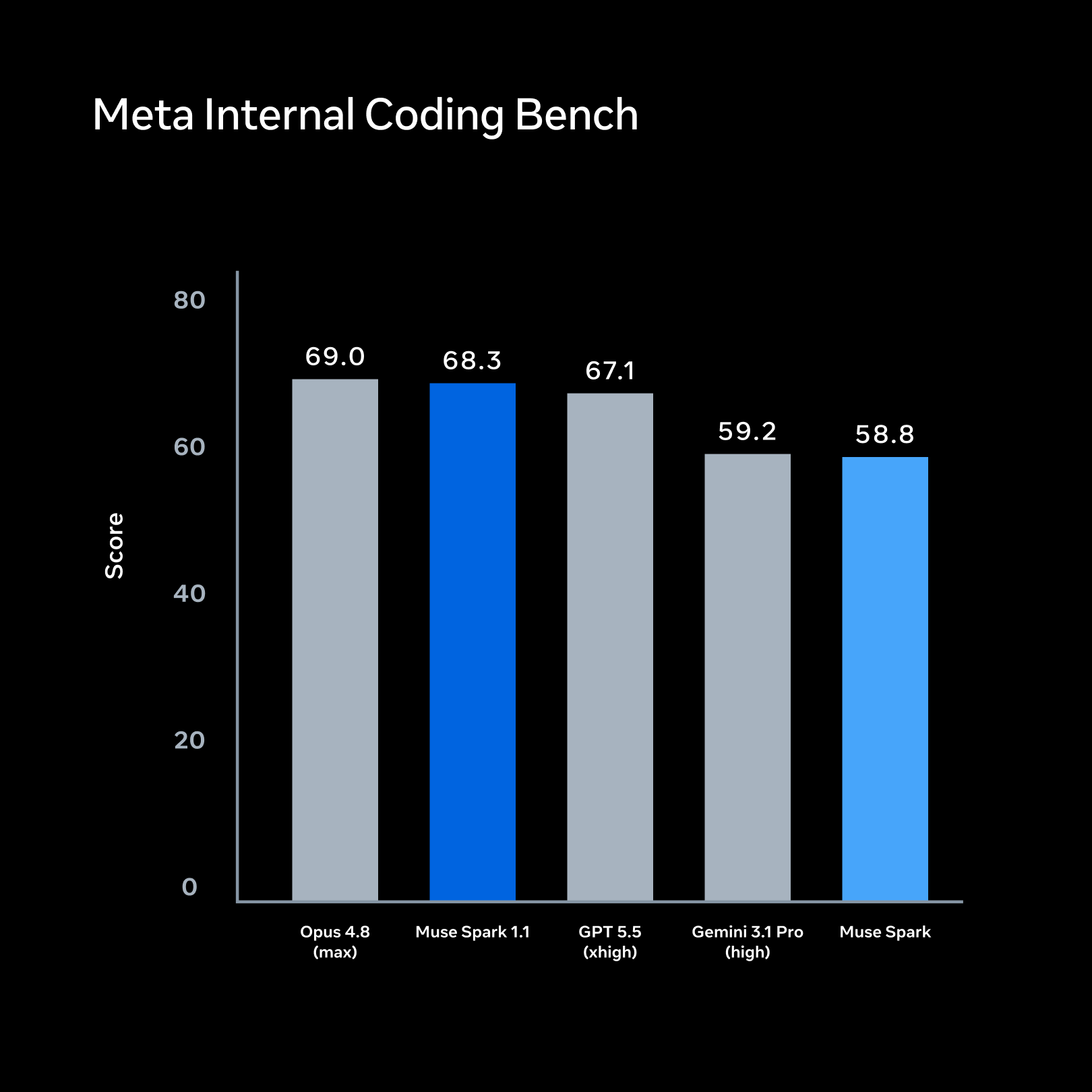
Large repos, self-checking UI via screenshots; internal coding bench is neck and neck with Opus; pricing is friendlier for long-running tasks (cached input at $0.15).
Desktop + browser + mobile computer use; long tasks where requirements change mid-stream are the official demo's focus.
Feed in video/screenshots, then drive the browser to complete actions like listing a product or filling out a form.
Availability: Thinking mode in the Meta AI App and meta.ai; developers go through the Meta Model API public preview. Muse Image / Video, launched the same week, is a separate media-generation line.
Getting AI to work: from "one assistant clicking through step by step" → "one manager running a team of clones at once"
Meta released Muse Spark 1.1 and opened its API (an interface letting other software call it) for the first time. One illustrated page on how it runs a team of clones through long computer tasks, and whether it's affordable.
↓ Read the whole page · one animated diagram inside
Muse Spark 1.1 is an AI model released by a Meta lab on July 9, 2026. Its whole point is getting AI to operate a computer on its own (clicking buttons, typing, scrolling, using interfaces like a person would), write code, and read images to get things done — not just chat with you. But for it to actually pull off a "long job" solo, the old approach always hit the same wall:
✘ Carrying a long job alone across several steps and several apps — say, organizing an 8-person dinner: checking the menu, checking inventory, tracking headcount, seeing it through start to finish
The old AI ran a single track by itself with no division of labor; long conversations meant it forgot what came before; and if requirements changed mid-task, you had to re-issue the instruction yourself.
The biggest change this time is how it works. It's learned to act like a project manager: think through the plan first, then split the work across several "clones" to run at once — and its memory can hold about 1 million words (1 million tokens, a token being the smallest unit of text an AI processes), automatically deleting idle chatter and keeping key decisions when it can't fit everything.
Ran a single track from start to finish by itself, forgot earlier context once memory filled up, and needed you to re-issue instructions when requirements changed mid-task — and it only lived inside Meta's own app, with no way for outside developers to plug in.
The lead AI splits work across several clones running at once, compresses its roughly 1-million-word memory on its own — keeping only the key steps — and notices mid-task changes and revises the plan itself; it's also opened an API for the first time, so two lines of config plug it into your own tools: api.meta.ai/v1 · muse-spark-1.1
So how does "lead AI running clones" actually play out? Let's walk through the official dinner-party demo.
Say XiaoHu asks it to organize an 8-person dinner. Instead of running a single track from start to finish itself, it plans first, then sends several clones out at once to check the menu, check inventory, and track headcount — and when someone suddenly mentions a dietary restriction mid-task, it notices on its own and adjusts the order.
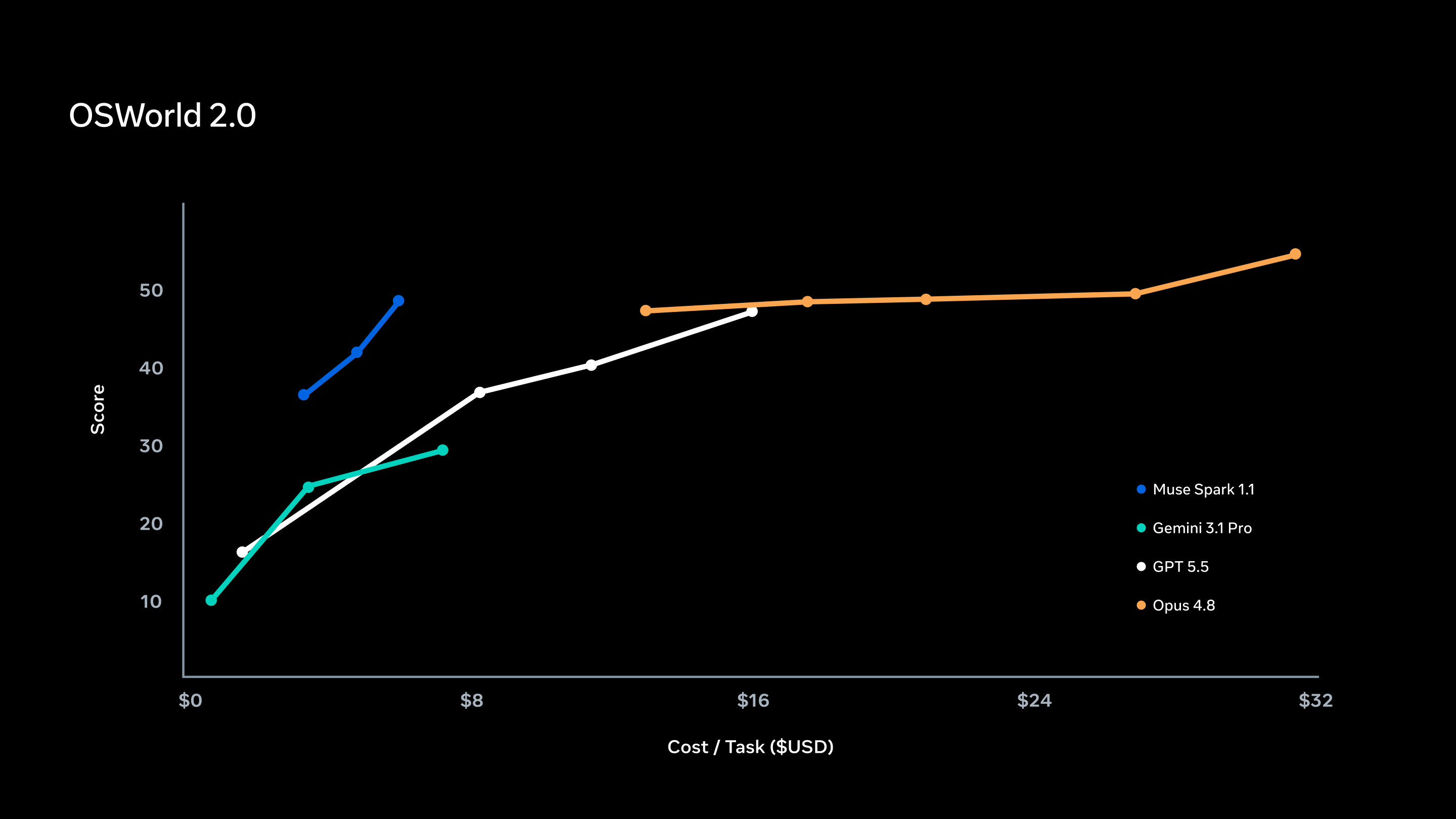
Meta's pitch is "performance holds up, price comes down." The most tangible measure is how much it costs to have AI operate a computer on its own to finish a task. In the official OSWorld 2.0 test (having AI operate a real computer interface to get things done), at the same score band, a single Muse Spark task runs about $6–7 — cheaper than other leading models at the same score band.
(same score band)
- × One track, no division of labor
- × Forgets what came before
- × Plans change? You re-explain
was coming again?
now a manager who delegates.
keeps key decisions
once memory's full;
this one tidies up itself.
doing all this at once?
splitting work across clones running at once
updates the order
for a task costs about $6–7 at the same score —
cheaper than the rest.
it's running a team through long jobs like a manager
two lines of config
into your own tools
Primary source and reference
- Meta AI / Alexandr Wang Original publisher