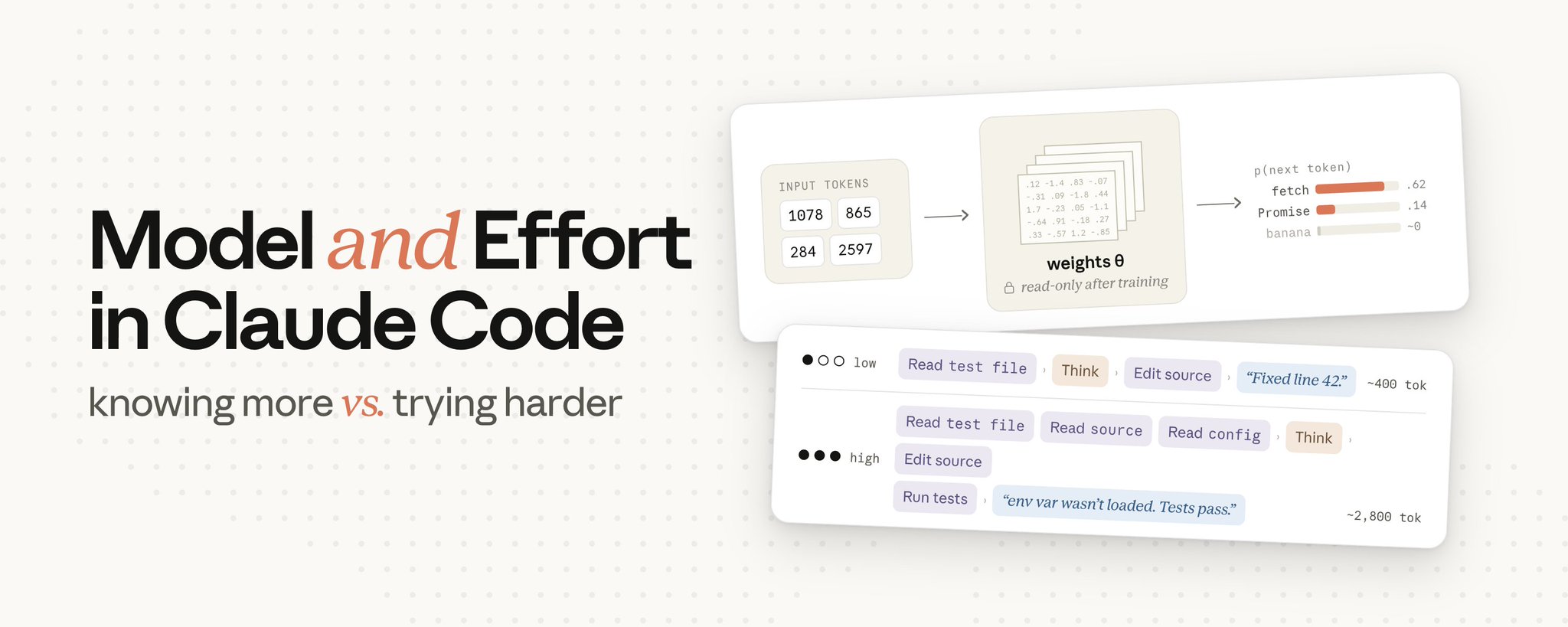
The Claude Code team teaches you how to work these two knobs: one controls whether it "can," the other controls whether it "will do enough"
- Anthropic's developer-facing account @ClaudeDevs published a long-form post on July 8, 2026, written by Claude Code team member Lydia Hallie (@lydiahallie).
- Effort controls how much work Claude does overall on this task: how much it thinks, how many files it reads, how many tests it runs, how much it verifies, and how far it pushes through multi-step work before asking you. The API commonly exposes five tiers: low / medium / high / xhigh / max; for most tasks, the model's default tier is enough.
- The model setting decides which trained, frozen set of weights you're using — in other words, what it "knows." Effort decides "how thorough it is." When it gets something wrong, first check the context, then ask: is it that it "can't," or that it "didn't try hard enough"?
- Role analogy: Fable is like a specialist, Opus is like an expert, Sonnet is like a solid generalist; effort is how long they're willing to spend on your case.
- On simple tasks, bigger models cost more; on hard, multi-step tasks, bigger models can sometimes come out cheaper overall, and can finish work that smaller models simply can't. In testing, Opus 4.8's default effort used roughly the same token volume as Opus 4.7's default, with better results.
Two knobs that both look like they "make the answer better"
On July 8, 2026, Anthropic's developer account @ClaudeDevs published a long-form Claude Code post, written by Claude Code team member Lydia Hallie.
What effort is: same model, how thorough this particular job gets done
In Claude Code, effort is a setting that sits alongside model choice. It doesn't change whether the model "can" do something — it tells that same model how much work it's willing to put in before handing back an answer this time. The common misconception is treating effort as "thinking longer"; really it governs how thorough the whole job is.
The post puts it plainly: effort controls how much work Claude does overall on this request — not just how long it thinks, but also:
Whether it opens up more source code, config, and logs, or just looks at what you pasted into the chat box
Whether it runs tests after making a change, double-checks its conclusion, or scans for edge cases on its own
On a multi-step task, how far it drives forward in one go versus quickly stopping to ask you for more context
Whether it writes a plan first and how deep that plan goes, and whether it verifies once more after finding an answer
In the API docs, effort is a behavioral signal, not a hard token cap: at a low tier, a genuinely hard problem may still get real thought, but on the same problem it will "think and do less" than a high tier would. The tiers the docs list run, from cheapest to most aggressive, roughly five deep (in the Claude Code interface you'll also see an "ultracode"-style entry bundled with multi-agent permissions — that's a product-side combination, not an extra API tier name).
Primary source and reference
- ClaudeDevs(X)/ Lydia Hallie Original publisher