
1X Unveils NEO's New Dexterous Hand: It Can Feel What It's Holding While It Works
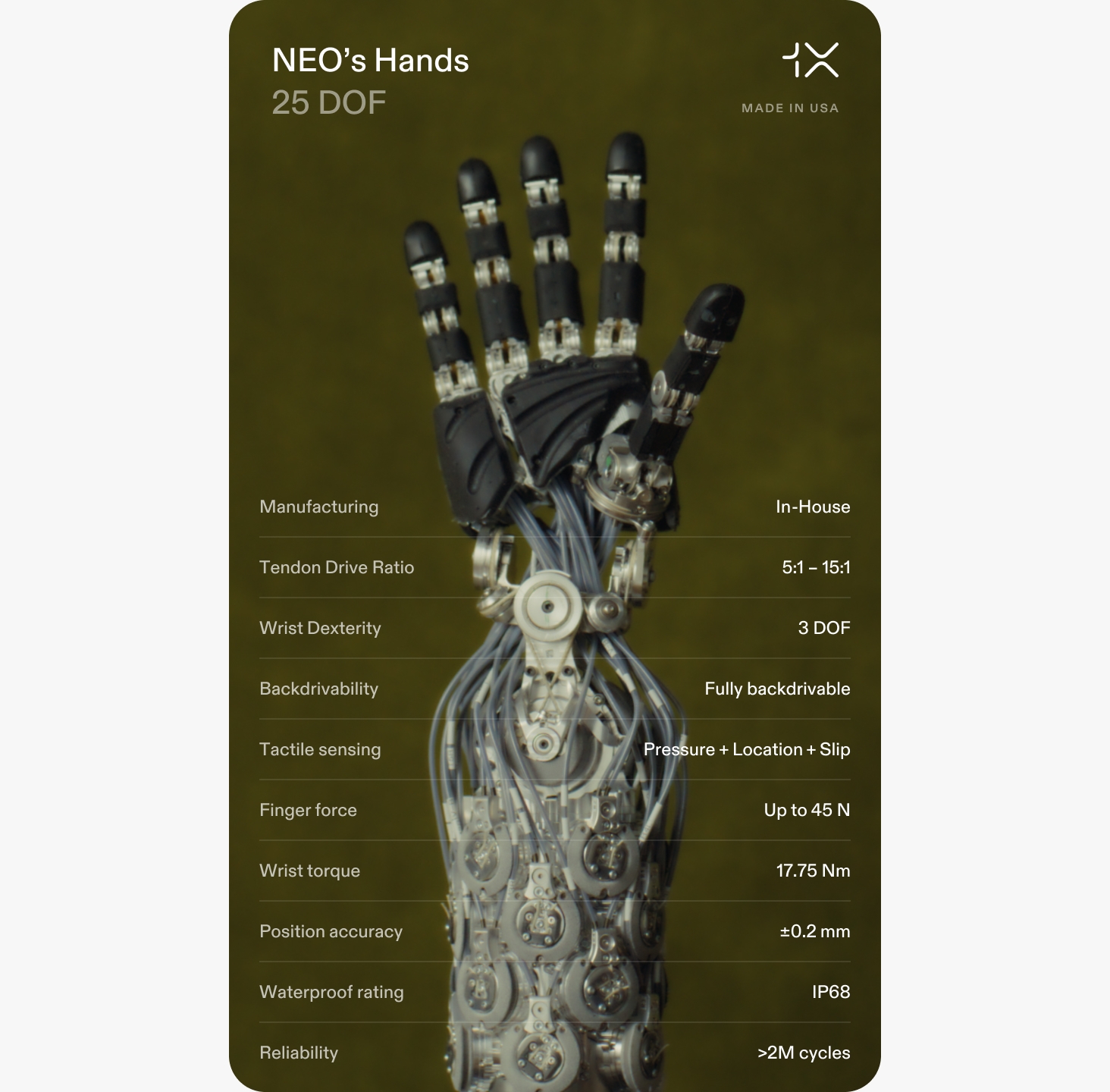
- 1X Technologies unveiled the next-generation hand for its NEO humanoid robot, with 25 degrees of freedom total: 22 in the fingers and palm, 3 in the wrist.
- It's tendon-driven with an unusually low reduction ratio of roughly 5:1 to 15:1. Every joint is force-controlled and back-drivable, meaning it can sense external force instead of just executing position commands.
- The fingertips and palm are covered in high-resolution tactile skin that measures normal force, contact location, and shear force, letting it detect slipping in real time and adjust its grip.
- Peak torque: 3.5 Nm at the thumb's CMC joint, 2.6 Nm at the finger MCP joints, up to 45 N of fingertip flexion force, 17.75 Nm of wrist torque, and ±0.2 mm positioning accuracy.
- Hundreds of hand units have already rolled off the line, with a dedicated production line planned to hit 10,000 units a year by 2026; the whole hand is IP68 waterproof, built from food-safe materials, and can be washed by hand.
1X gives NEO a new pair of hands
On July 9, 2026, 1X Technologies unveiled a new-generation hand for its NEO humanoid robot — a 25-DOF, fully force-controlled, back-drivable tendon-driven hand modeled on human anatomy.
See what it can do first
Before we get into the mechanics, let's look at what this hand can actually pull off. The official demos are all tasks that require finger coordination.
These aren't specially tuned demo modes. They're the natural outcome of packing enough independently force-controlled joints into a human-scale hand.
Where the ordinary robot gripper hits its ceiling
To understand the weight of this launch, you first need to see where today's humanoid robot hands are stuck. The common approach on the market is a position-controlled two-finger gripper: you give it a target position, and it opens or closes to reach it.
For a developer, a hand like that exposes exactly three actions: pick, place, push. Every application built on this kind of hand is just some combination of those three moves — done blind, eyes closed. The ceiling isn't in the software; it's at the end of the arm.
The deeper problem is in the transmission. To amplify a small motor's torque into something usable, this kind of hand typically uses a high reduction ratio of 100:1 to 200:1. The cost: before an external contact force can travel back to the motor, it's absorbed entirely by friction in the gears. The hand has no sense of what it touched or how much force it used — engineers can only mount a camera outside and guess what the fingers are doing.
This hand knows what it touched while it's touching it
The idea behind this new NEO hand is to have it read the outside world's response back in real time, at the same moment it's acting on it.
NEO's hand is tendon-driven, with an unusually low reduction ratio of 5:1 to 15:1. All 25 joints are natively force-controlled and back-drivable. Push on one of its fingers, and it yields with the push while precisely reporting how much force you applied. Force flows out through the hand, and information flows back through the same physical channel. 1X calls this "force transparency" — the act of pushing on a finger is itself a measurement.
It's like a car in neutral: you can push it and feel how heavy it is from the resistance. Put it in park and it won't budge no matter how hard you push, and you won't feel a thing either. The high reduction ratio in a traditional robot hand is that locked park gear.
The key here is tendon drive: the motor doesn't sit in the joint — it's mounted in the forearm, pulling the finger joints remotely through cables that act like tendons. It's a bit like a puppet show: the motor is on a distant control stick, thin strings tug at the puppet's fingers, and the fingers themselves can stay very light.
- Write-only, no read — commands a position, and it goes there
- 100:1 to 200:1 high reduction ratio
- Contact force absorbed by gear friction
- Guesses what the hand is doing via external cameras
- Reads and writes — the action itself is the measurement
- 5:1 to 15:1 ultra-low reduction ratio
- All 25 joints force-controlled and back-drivable
- Force and information flow both ways on the same tendon
There's also a quiet channel running in the background called proprioception. Because every joint is closed-loop controlled, the hand knows its own pose and how much force each part is applying without looking — the same way you can touch your two index fingertips together with your eyes closed.
How to split 25 joints for both dexterity and strength
Degrees of freedom refers to the number of independent directions a joint can move — roughly, one DOF corresponds to one point that can be controlled independently. 25 degrees of freedom means there are 25 spots on this hand that can each move independently. Beyond the count, how they're allocated matters more.
Enough force-controlled DOF at a human-hand scale adds up to both dexterity and strength. Here are the hand's hard numbers.
That much strength allows full-hand grasps, tool use, carrying things, opening doors, pushing a loaded cart, and precise pinching under load — all while keeping full dexterity. The ±0.2 mm positioning accuracy lets it work at the "small object" scale where most human labor actually happens.
The last half-millimeter, on the fingertip
Force control alone isn't enough — the information in that last half-millimeter at the fingertip has to come from skin. NEO's fingertips and surface are covered in high-resolution tactile skin that continuously measures three things.
The most direct use of this skin is catching slips in real time. The instant an object starts to slide, the shear-force channel picks it up, and the force-controlled joints immediately tighten or adjust the grip to stabilize it before the slide completes.
senses slip onset
adjusts grip in real time
Vision alone can't do this, especially with objects that are transparent, fragile, deformable, or occluded. Official demos show a normal-force contact map, a pressure heatmap during a handshake, and pinching up a fragile paper crane without crushing it. This skin is designed together with the sensors inside it and the tendons behind it — it's a functional material, not a cosmetic layer.
What happens when it's hit with a hammer or caught in a drawer
A hand that learns by touch has to survive being touched, over and over — and it also has to be safe around people.
This hand's safety comes from its "compliance." The extremely low reduction ratio, combined with tendon drive and very low fingertip inertia, lets an external impact safely push the finger back and absorb the blow smoothly. In the official slow-motion clips, the fingers yield gracefully in every one of these situations.
Reliability is engineered into every subsystem: tendon routing, bearings, finger structure, cable routing, tactile integration, electronics, assembly. Individual parts and full finger assemblies have been tested through millions of cycles, drive units have been tested at extreme temperatures, and the wrist joint has been validated for over 2 million cycles under high load. The whole hand is sealed to IP68, uses food-safe materials, and can be washed by hand at a sink when it gets dirty.
Being able to manufacture it is the real moat
The last number — and the strategic point 1X is emphasizing — is production capacity.
First, how the hardware delivers all that force. The motors sit in the forearm, roughly where most of a human hand's grip strength comes from, pulling the fingers through 1X's proprietary tendons that run through the wrist. That's how the hand can stay light while producing serious force, and keep running continuously without overheating.
The whole hand is deeply integrated as part of the full NEO robot: in-house motors, custom electronics, embedded sensing, a proprietary tendon system, a compact transmission, and hand-specific firmware. From the tendon material down to the outermost soft polymer, the skin, and the tactile sensing stack — every hand is built end-to-end on 1X's own production line.
Hundreds of hand units have already rolled off the line, with a dedicated production line planned to reach an annual capacity of 10,000 units by 2026. Here's why capacity is really the point of this launch: a hand that can't be manufactured at scale can't run experiments at scale. Without large-scale real-world grasping data, you can't train a manipulation model that actually works. How many hands you can build directly determines how fast the manipulation model can learn.
Our goal was never a hand that just looks good on paper. These hands are the product of intensive engineering, aimed at making humanoid robots genuinely useful. We want them to match or exceed human capability on every dimension that matters. With this hand, NEO has crossed a critical threshold: robots can now do what people do with their hands every day. This is what the industry has been waiting for. Bernt Børnich, Founder and CEO, 1X
The Robot Hand: From Blind Grabbing → Feeling What It Holds While It Works
1X gave its NEO humanoid robot a new pair of hands, with all 25 joints able to sense external force — one illustrated page to explain why it's different.
↓ One page, fully explained · one animated figure inside
NEO is a humanoid robot made by 1X (the goal: a robot that helps with housework). The hand is where a robot actually does the work — and where it learns what it's doing. Most robot hands today are "two-finger grippers," a clamp that opens and closes. Here's the problem:
✘ Can't feel what it's grabbing or how much force it's using
Why: to make a small motor produce a big force, the gripper's gears amplify force 100 to 200 times (this multiplier is called the "reduction ratio," 100:1–200:1). The cost: before the reaction force from pushing on a finger can travel back to the motor, it's already absorbed by friction across layer after layer of gears. The hand is completely "mute" about itself — engineers can only mount a camera nearby and guess what it's doing.
1X changed the approach: have the hand read the outside world's response back, at the same time it's acting. Push on one of its fingers, and it yields with the push while precisely reporting how much force you applied. 1X calls this "force transparency" (force and information flow both ways through the same channel). The method is "tendon drive" (motors sit in the forearm, pulling the finger joints remotely through cable "tendons"), paired with an unusually low reduction ratio.
Reduction ratio 100:1–200:1
Contact force absorbed by gear friction
Guesses what the hand is doing via external cameras
Only 3 actions: pick, place, push
Reduction ratio 5:1–15:1
All 25 joints (22 finger/palm + 3 wrist) force-controlled and back-drivable
Fingertip tactile skin catches slips in real time and tightens the grip
Yields gracefully when bumped or caught, safer around people
It can genuinely do fine work that needs finger coordination: building LEGO, pinching coins out of a wallet, screwing in a lightbulb. So how exactly do force and information run both ways along "the same tendon"? One figure below makes it click.
Simple scenario: XiaoHu reaches out and pushes on one of NEO's fingers. The exact same push takes two completely different paths on the old gripper versus the new hand.
"A 5:1 reduction ratio" means nothing to most people, but it's exactly what decides whether this hand can "feel": the reduction ratio is the amplification factor of the gears between the motor and the joint — the higher it is, the more easily the force of pushing on the finger gets absorbed by gear friction. Here's how far apart the two approaches are:
All performance figures above come from 1X's own internal testing, with no third-party reproduction yet; the 10,000-unit figure is a planned 2026 capacity (a forecast), not something already achieved.
its finger,
- × Can't feel what it grabbed
- × Doesn't know how much force it used
- × Just grabs blindly on command
can feel force
that old clamp…
reduction ratio
capacity by 2026
Primary source and reference
- 1X Tech Original publisher